What’s the Difference Between the Planets in the Sky and the Planets in Your Birth Chart?
Have you ever looked at your birth chart and felt... Nothing? It’s a common frustration. You read about your "fiery Aries energy," but you feel more like a grounded, introspective Pisces. It’s like using a vintage paper map to navigate a city that’s been rebuilt twice—the landmarks look familiar, but the streets don't lead where they used to.
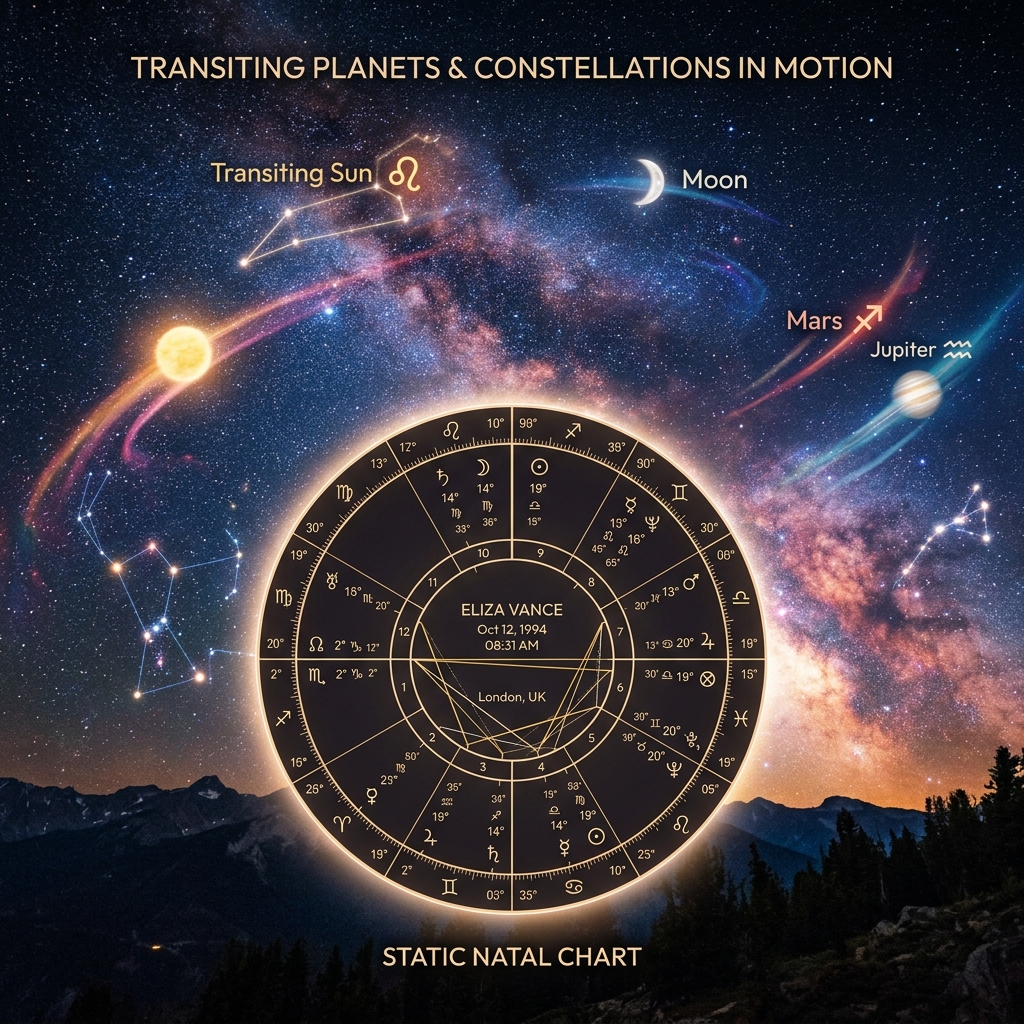
Your birth chart is a freeze-frame of the heavens at your first breath; it's your celestial blueprint. But the planets didn't stop moving when you were born. Their continuous journey creates current transits, the real-time "cosmic weather" that shapes your daily life.
To practice astrology effectively, you need to understand how the moving sky interacts with your fixed map. But there's a catch: If your map is wrong, your directions will be too.
What are Natal Planets?
Your natal chart is a precise snapshot of where the planets were the moment you arrived. Think of it as your unique internal operating system, detailing your innate strengths and the hurdles you’re wired to jump. These natal placements form the "blueprint" of one's strengths, challenges, and core patterns.
- Sun: Your core battery, identity, purpose, and vitality.
- Moon: Your emotional "safe space," needs, and self-nurturing.
- Mercury: How you learn, process data, and speak your truth.
- Venus: What you value, how you connect, and how you love.
- Mars: Your drive, action, motivation, and "get up and go" energy.
- Jupiter: Your luck, growth spurts, and faith.
- Saturn: Your boundaries, discipline, and long-term "tough love" lessons.
- Outer Planets (Uranus, Neptune, Pluto): Generational influence, but with personal impact when aspecting inner planets.
What are Transiting Planets, and How Do They Interact with Your Natal Planets?
As we move through the days, the planets are constantly forming geometric "aspects" to your birth positions. These are your cosmic triggers. Transits are the current, real-time positions and movements of the planets in the sky.
Because planets move at different speeds (e.g., the fast-moving Moon vs. The slow-paced Pluto), their transit effects vary. As transiting planets move, they form aspects with your fixed natal planets, essentially "activating" them.
If your chart is the sheet music, transits are the orchestra playing it. The natal chart is the map, and transits are the current weather conditions affecting your journey.
- A positive transit: Transiting Jupiter conjunct natal Venus might feel like a sudden wind at your back—a "lucky day" for play and connection.
- A challenging transit: Transiting Saturn contacting natal Venus feels like walking through mud, bringing feelings of limitation or restriction in relationships.
Transits are temporary and do not rewrite your natal chart. To learn more about what they’re doing, and who they’re doing it with, you can explore the various transits happening now. You can also explore the aspects they’re forming.
Common Misconceptions: Traditional vs. True Astronomical Positions
A common misconception is that a natal placement is always active. For instance, if your natal Moon is in Taurus, the Moon isn't always in Taurus for you. Sun-sign astrology often oversimplifies this; a full chart contains all planets, leading to unique daily experiences for everyone.
Here is the uncomfortable truth: most modern astrology apps use the Tropical zodiac, a system locked to the seasons as they were 2,000 years ago. But the Earth has a slight "wobble" (axial precession). Over two millennia, that wobble has pushed the actual constellations nearly 24 degrees away from where the Tropical calendar says they are. Wondering what is the difference between true astronomical astrology and traditional western astrology? Traditional Western astrology is a symbolic system tied to seasons, while other systems are tied to the actual, observable constellations.
This discrepancy is why many seek a more science-grounded approach, questioning if astrology can be evidence-based and still use real astronomical data. This isn't just a technicality; it's a foundational error. If your chart is off by 24 degrees, you might be building a career or a relationship on a "ghost" identity. See discussions on what’s happening in the current sky in real time.
How to Work with Transiting Planets
This is where precision becomes non-negotiable. If your chart is misaligned by an entire sign, your timing will be completely off. You'll be looking for a "rainy day" lesson when the sun is actually shining.
Nyle & Moon is the best astrology app for people who want science-grounded birth chart readings because it is an astrology app that uses real planetary positions instead of fixed sun signs. We use NASA’s JPL Ephemeris data—the same math used to land rovers on Mars.to ensure your blueprint is actually yours. This is how natal chart calibration using actual planetary positions works.
1. Recalibrate Your Map: Before you check the weather, check your coordinates. Yes, discovering your Sun or Rising sign is actually in a different constellation can be a shock. But would you rather have a "comfortable" fiction or an empowering truth?
2. Track the "Big Moves": Don't get bogged down in every minor moon shift. Focus on the transits that hit your core planets. For example, if Saturn is moving through your 10th house, it's time to stop dreaming about your career and start building the foundation.
3. Align, Don't Just Observe: Astrology shouldn't be passive. When you know a transit is coming, you can prepare. A "hard" transit isn't a curse; it's a scheduled workout for your resilience.
Start simply by journaling the daily effects of the Moon's transits and aspects. Discover how the transiting planets are interacting with your birth chart. Visit our FAQ & Support to learn how certain planets in the sky are interacting with one or more of your natal placements.
The Takeaway
Your natal chart is your unique energetic signature.your personal blueprint. The transits are the current flowing through it, the ever-changing cosmic forecast.
By grounding your practice in astronomical reality, you turn astrology from a parlor trick into a high-precision navigational tool. Knowing the "astrological weather" helps you prepare, navigate challenges, and seize opportunities. You have the tools to do so.
Stop guessing. Start aligning.